
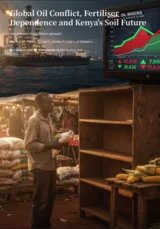
Global Oil Conflict, Fertiliser Dependence and Kenya’s Soil Future

Global oil conflicts are not just energy issues; they are food system shocks.
This dossier shows how disruptions in oil markets ripple through fertiliser supply chains and into agriculture, increasing production costs and exposing countries like Kenya to global instability. Because most synthetic fertilisers are derived from fossil fuels and imported, Kenya’s farming systems remain tightly linked to energy markets and geopolitical dynamics.
However, the analysis goes beyond price volatility to highlight a deeper structural problem: dependency. Modern food systems rely heavily on external, fossil-fuel-based inputs, not only for fertiliser but also for transport, processing, and packaging. This makes them inherently vulnerable to global shocks.
At the same time, evidence from the Soil Atlas and scientific research underscores that fertiliser alone cannot sustain productivity in degraded soils. Soil health, driven by organic matter, biological activity, and ecological processes, is the true foundation of long-term fertility and resilience.
The article argues that the solution is not simply to secure more fertiliser, even in “green” forms, but to rethink the system itself. Strengthening soil health through agroecological approaches, such as composting, agroforestry, and crop diversification, can reduce dependency on external inputs and build more stable, resilient food systems.
Kenya already has policy frameworks and farmer-led practices pointing in this direction. The key question is whether this moment of crisis will trigger a meaningful transition or whether cycles of dependency and vulnerability will persist.