
Article
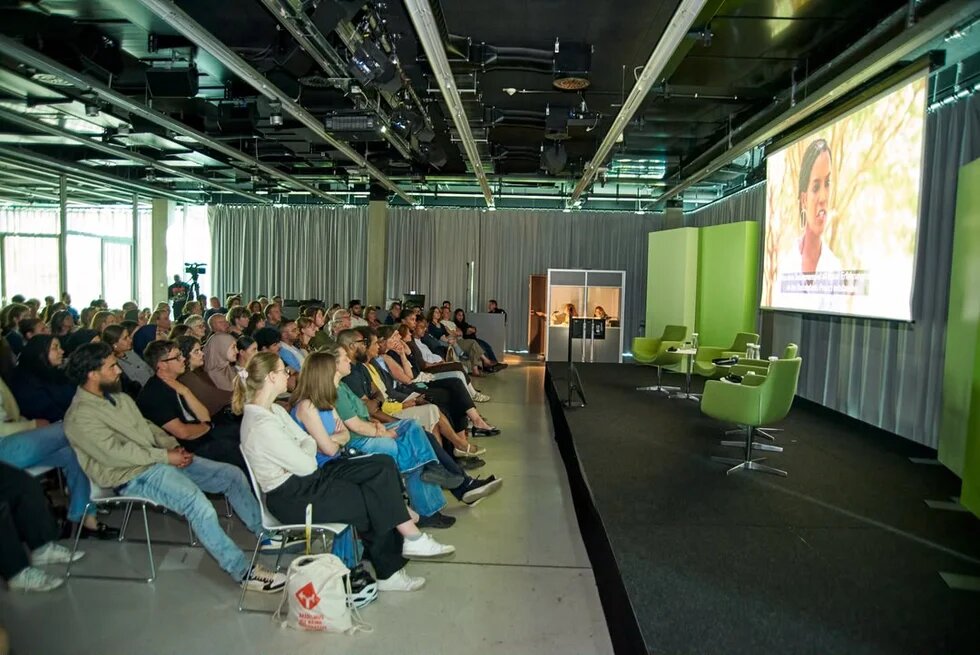
OnJune 9th, 2026,evening in Berlin, inside the halls of the Heinrich Böll Foundation, I found myself sitting with a room full of people-some physically present, others joining through a livestream that stretched far beyond Germany. We had gathered to watch and discuss Echoes Across the Atlantic, a documentary that follows a group of young remembrance activists travelling from Berlin to New Orleans. But what unfolded that evening was more than a film screening. It was an encounter with history, with discomfort, and with the fragile yet urgent act of listening.

On June 9th, 2026, evening in Berlin, inside the halls of the Heinrich Böll Foundation, I found myself sitting with a room full of people-some physically present, others joining through a livestream that stretched far beyond Germany. We had gathered to watch and discuss Echoes Across the Atlantic, a documentary that follows a group of young remembrance activists travelling from Berlin to New Orleans. But what unfolded that evening was more than a film screening. It was an encounter with history, with discomfort, and with the fragile yet urgent act of listening.
The film does not offer easy narratives. It resists the simplicity of a travelogue. Instead, it lingers in pauses, in silences, in the quiet tension of standing before sites marked by violence and memory. The young participants, many with different migration backgrounds and lived experiences of racism, do not arrive as experts. They arrive as listeners. And through that act, something begins to shift.
Watching them, I kept asking myself: what does it mean to listen to history-not as something distant, but as something lived, inherited, and still unfolding?
This question stayed with me throughout the panel discussion that followed, where I shared the stage with voices such as Joy Banner, “Descendants Project co-founder” and Karlos Hill, “Black History professor University of Oklahoma” guided by the thoughtful moderation of Josephine Apraku,“African studies scholar and moderator” Together, we tried to unpack what it means to move from remembrance to responsibility.
The Missing Ocean in Global Memory
In many international conversations about colonialism, the transatlantic narrative dominates. The story of slavery, plantations, and the Middle Passage is rightly central-but it is not the whole story. From my position as a historian and curator working in Tanzania, I often find that East Africa and the Indian Ocean world are treated as footnotes.
Yet our histories are deeply entangled with these global systems of extraction and violence.
The German colonial presence in Tanzania, for example, is often remembered for events such as the Maji Maji War. But beyond resistance, there are quieter, more dispersed traces: archives scattered across Europe, human remains stored in foreign institutions, and cultural objects removed from their contexts. These are not just historical facts; they are absences that continue to shape how we understand ourselves.
This is why listening matters. Because listening allows us to recognise that history is not singular but layered, contested, and often unevenly told.
Places That Speak
In my work, I often move between film, archives, and public spaces. One thing has become clear to me: places carry a kind of knowledge that cannot be fully captured in books or statistics.
A former plantation, a slave fort, a colonial administrative building-these are not neutral sites. They are charged with memory. They hold contradictions. They invite different people to see different things.
In Ghana, for instance, a slave fort may be visited by local communities, descendants from the diaspora, tourists, and researchers-all at once. Each brings their own expectations, their own claims, their own emotional investments.
Can one place hold multiple memories at the same time?
I believe it must. But that coexistence is not always comfortable. It requires negotiation, humility, and sometimes confrontation. It requires acknowledging that memory is not only about the past-it is about power in the present.
From Symbolism to Structural Change
During the discussion, we were asked a critical question: if remembrance is to be more than symbolic politics, what concrete change should we expect in the next five years?
This is where the conversation inevitably turns to restitution.
In recent years, political statements-such as those byFrench PresidentEmmanuel Macronon restitution have suggested that the return of African cultural heritage is “unstoppable.” And yet, nearly a decade after such promises were made, progress remains slow. Bureaucratic processes, legal frameworks, and institutional hesitations continue to delay what many Africans see as a matter of justice.
The reality is stark: up to 90% of sub-Saharan Africa’s material heritage is held outside the continent. To imagine a country with only 10% of its history physically present is to imagine a profound rupture-not just of objects, but of knowledge, identity, and continuity.
Restitution, therefore, cannot be reduced to the movement of objects from one place to another. It must be understood as repair.
Repair of knowledge. Repair of memory. Repair of dignity.
As Nigerian writer and colonial critique Chinua Achebe reminds us, colonial systems did not prepare African societies for the political structures they later inherited. They imposed systems of control, not participation. To speak of restitution without addressing these deeper disruptions is to misunderstand its purpose.
Tanzania and the Journey Home
In Tanzania, the conversation around restitution is gaining momentum. There are ongoing efforts to identify and reclaim human remains taken during the colonial period, as well as cultural artefacts held in European museums. But beyond the legal and diplomatic processes, there is a deeper question: what does it mean for these histories to return?
For me, it is not only about bringing objects back. It is about reactivating them within communities. It is about integrating them into education, into storytelling, into everyday life.
It is also about confronting the internal legacies of colonialism-borders, systems, and structures that continue to shape African realities today. Arikana Chihombori-Quao,“former Permanent representative of the African Union to the United States”powerfully argues, the divisions created during the Berlin Conference are not relics of the past; they are living frameworks that still influence how Africa functions.
To speak of restitution, then, is to speak of a broader reimagining of the continent’s future.
Listening as a Political Act
What Echoes Across the Atlantic makes clear is that listening is not passive. It is a political act.
The young people in the film do not simply absorb information. They allow themselves to be unsettled. They confront histories that implicate not only institutions, but identities. In doing so, they model a form of engagement that is deeply needed in our current moment.
For audiences in Africa, this raises important questions. How do we listen to our own histories? How do we engage with the fragments that remain, and the absences that persist? And how do we ensure that our voices are not only included in global conversations, but actively shaping them?
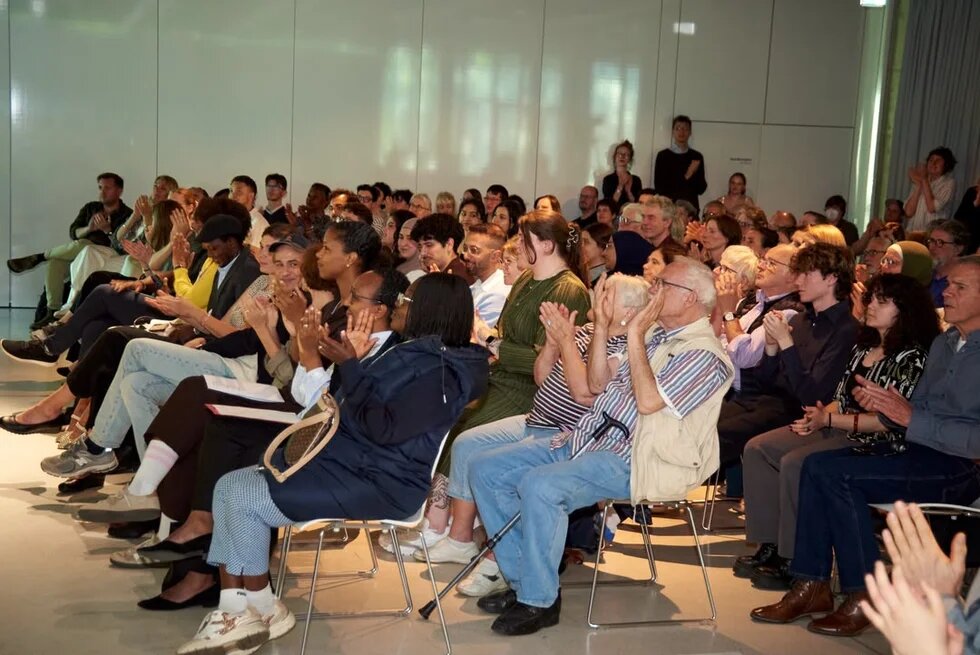
The Berlin event, attended by over 200 people in person and nearly 400 online, demonstrated a growing appetite for these discussions. But interest alone is not enough. What is needed is sustained dialogue, collaboration, and a willingness to move beyond comfort.
Toward a Shared Future
Restitution debates often position Europe and Africa as opposing sides-one holding, the other demanding. But the more productive approach is to see this as a shared challenge.
How can European institutions move from acknowledgement to action? How can African countries prepare to receive, interpret, and integrate returned heritage? And how can both engage in a process that is not extractive, but restorative?
These are not easy questions. But they are necessary ones.
As I left the event that evening, I was struck not by a sense of closure, but by a sense of opening. The conversations we began in Berlin are far from finished. In many ways, they are only just beginning.
And perhaps that is the most important lesson: that memory work is not about arriving at a final answer. It is about staying in the process-listening, questioning, and imagining new possibilities.
Because history, like the ocean it so often crossed, does not stay in one place. It moves. It connects. It returns.
The question is: are we ready to receive it?
“Echoes Across The Atlantic–Memory in Dialogue” Full event is available online on Heinrich Böll Stiftung YouTube Channel: https://youtu.be/XKHUVq4I0JM?si=5t2JN-5giXJr7N2z


