
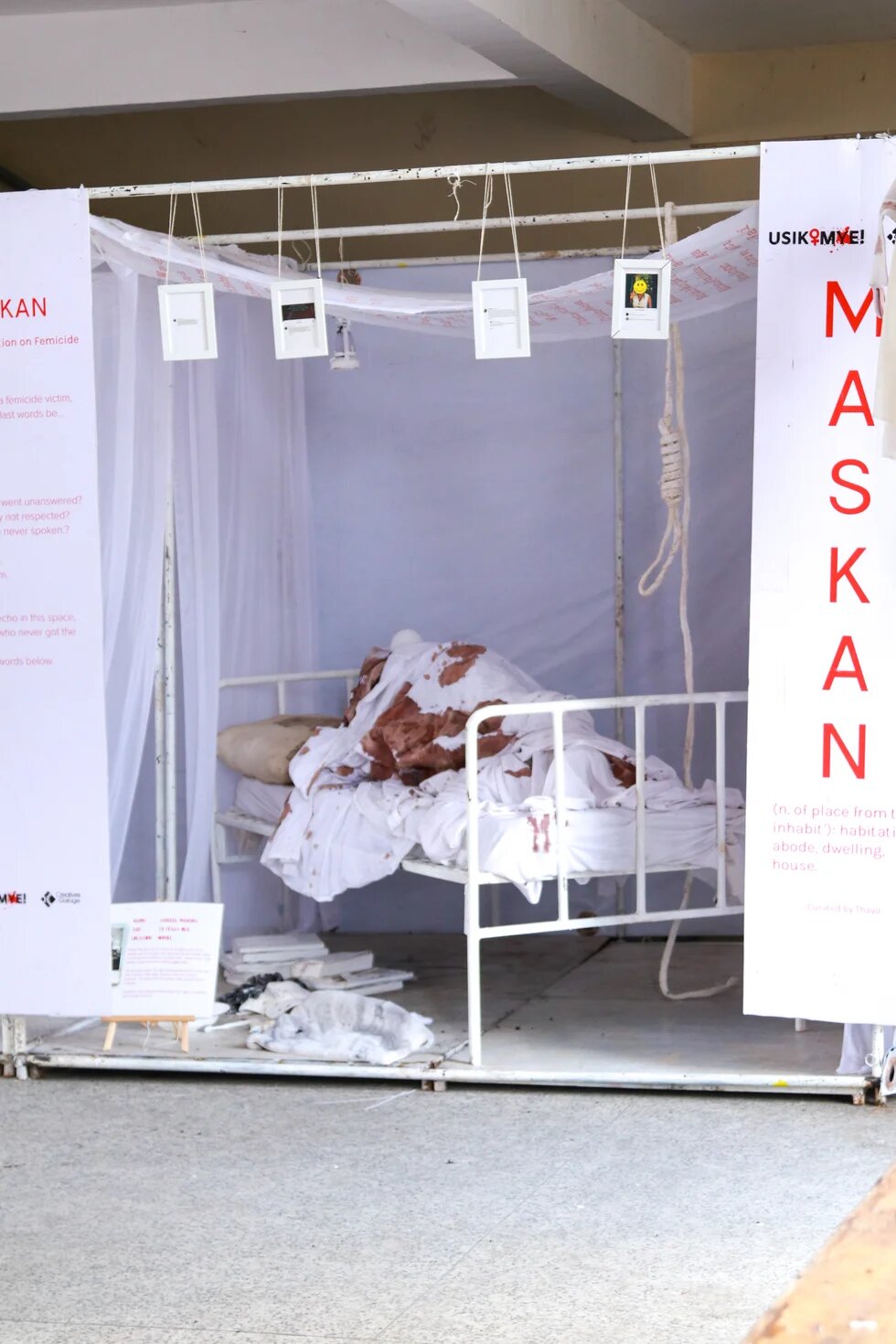
Through evocative installations and community engagement, Maskan Tour, done in collaboration with Usikimyie and Creative Garage, turns abstract statistics on femicide and policy failures into visceral, human stories that demand accountability. Explore how this unique exhibition bridges the gap between written policy and lived experience, sparking public dialogue and driving real change in the fight for justice.

In the heart of Nakuru City, the municipal hall has been transformed from a mere civic building into a collective crime scene, a memorial, and a powerful civic assembly. This is Maskan edition, an immersive art exhibition where paintings whisper tragedies, installations map systemic failures, and poetry gives voice to the silenced. The Maskan exhibition tour Nairobi, Kisumu, Nakuru and Mombasa. went through. Beyond its role, it’s a space for healing and reflection. Maskan serves a critical yet often overlooked function: a living repository of policy evidence and a direct catalyst for governmental accountability.
While national headlines cite the stark figure of 160 femicides in Kenya in 2024, Maskan makes these statistics unbearably human by refusing to simply state that "72% of murders occur in the home." Instead, one installation reconstructs a living room, using audio testimony and fragmented décor to tell the story of a specific life lost within those walls, thus translating abstract policy failures into deep-seated, undeniable human experiences.
The most compelling evidence in the room was the reactions of those who walked through, such as the testimony of a visitor preparing to bury his five-months-pregnant sister: “Seeing this exhibition has rekindled my desire to seek justice and advocate for justice systems to be hastened.”
This statement is more than feedback; it is a data point for governance, capturing the exact implementation gap identified in national frameworks, the catastrophic delay and inefficiency in the justice chain. Maskan does what policy papers cannot: it transforms passive victims and grieving families into citizens who directly demand the execution of existing policies.
Maskan Nakuru’s curation is a strategic act of policy auditing, visually tracing what experts call the “accountability corridor” the journey a survivor or victim’s case should take through police stations, hospitals, and courtrooms.
One piece might juxtapose an unanswered recorded helpline call with the text of Kenya’s Protection Against Domestic Violence Act, visually highlighting the gap between law and practice.
Where a government report lists “case attrition rates,” an interactive display allows visitors to physically move tiles representing cases and watch them “fall away” at stages labelled “police refusal to file report” or “witness intimidation.”
This artistic mapping makes systemic failures co-owned by the public, answering the question, “Where exactly do our systems break down?” with tangible, shareable clarity, an understanding essential for demanding multi-agency cooperation.
The collaboration between Usikimye, Creatives Garage, and the Heinrich Böll Stiftung has engineered a model for participatory policy implementation. Maskan demonstrates four actionable mechanisms that can be integrated into formal anti-GBV strategies:
- Localized Evidence Generation: The exhibition transforms national data into Nakuru-specific narratives, creating relevant pressure on local duty-bearers, such as the county police commander, local judiciary, and county health officials, who are critical for on-the-ground policy execution.
- Community-Sourced Performance Metrics: The emotional reactions and written testimonies of thousands of visitors constitute a qualitative database. This data measures the public’s perception of state responsiveness, offering a crucial complement to quantitative bureaucratic metrics.
- Safe Space as Civic Forum: As a designated safe space, Maskan facilitates dialogue not only on trauma but also on solutions, serving as an informal yet powerful public forum where community consensus on policy priorities can form and solidify.
- Priming Public Mandate: By fostering empathy and outrage, the exhibition builds the public will needed to sustain political pressure for budget allocations, law enforcement reforms, and judicial training mandated by national task forces.
The Path Forward: Integrating Art into the Policy Cycle
The success of Maskan Nakuru suggests a fundamental shift is needed: artistic interventions must move from the periphery of “awareness raising” to the core of policy implementation and monitoring.
Concrete steps include:
- Formalizing Feedback Loops: Visitor testimonies from exhibitions should be systematically collected and presented as citizen reports to county governance committees and the national GBV taskforce.
- Budgetary Integration: County and national GBV action plans should allocate dedicated funding for artistic civic engagements as a legitimate line item for public accountability and monitoring.
- Replication as Strategy: The model should be replicated in other high-prevalence counties, adapting the approach to local contexts to build a nationwide network of community-driven accountability.
Maskan tour proves that the empathy sparked by art is not a soft outcome but a critical infrastructure for justice, forging the essential link between written policy and lived reality and transforming collective grief into an organized, evidence-based demand for action. In the fight against femicide, such exhibitions are not merely cultural events; they are essential sessions in the ongoing public audit of the state’s promise to protect its citizens.
The Maskan exhibition tour was featured on the Daily Nation here: ‘Every painting is a story’: How art is fuelling Kenya’s anti-femicide movement