For this edition of Perspectives the Heinrich Böll Foundation asked a number of African intellectuals, writers and analysts to provide their take on Africa’s relationship with Europe. The result is a small collection of interviews, short essays and comments that throw light on the complexities and complexes of this relationship, using analysis, imagery, experience, provocation and humour.
It is our hope that you really enjoyed reading the last issue #20 of the G20 and the BRICS UPDATE.
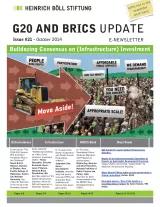
In this Issue, we look at how poor governance bulldozes consensus beyond the public eye, as the G20 is doing with regard to most aspects of its Global Infrastructure Initiative, which will be launched at the November Summit. The initiative will privatize aspects of governance in order to move from "retail" to "wholesale" investment strategies through use of “pooled funds” to finance large “portfolios” of public private partnership (PPP) projects (despite their demonstrated high failure rate). Below, part 1 reviews aspects of the G20’s Global Infrastructure Initiative and part 2 reviews the performance evaluation of World Bank-financed PPPs over a decade.
Enjoy!
This edition of the Perspective brings with it a wealth of facts on renewable energy, green economies, climate change and reflects on the challenges different African nations and entities are faced with, in their quest for a self-sufficient and sustainable green society. It is a rich compilation of expert commentaries and contributions coming from different parts of Africa, telling African stories.
PIDA, the Programme for Infrastructure Development in Africa, is poised to be a game changer for the transformation of Africa. This publication describes PIDA's plan to double levels of investment in energy, water, and transportation mega-projects and the opportunities and risks these projects present, asking the big question: will PIDA accelerate the colonial patterns of resource extraction or foster the economic diversification required for Africa to prosper?
Immediately after the World Cup Final, Brazil hosts the next BRICS Summit from July, 14th to 16th 2014. The leaders of Brazil, Russia, India, China and South Africa will come together and important announcements are expected: a new BRICS Development Bank and a Contingency Reserve Arrangement. On this occasion a special BRICS Summit Reader is available here presenting background analysis and facts.
Fossil resources like coal, oil and gas are responsible for 63 percent of carbon emissions in the atmosphere by only 90 entities – the “Carbon Majors”. This discussion paper outlines the case for the Carbon Majors to provide funding via the Warsaw International Mechanism for Loss and Damage for poor communities all over the world.
How could a just and democratic resource politics look like that respects both planetary boundaries and human rights? The Memorandum “Resource Politics for a Fair Future” is the outcome of a two-year international dialogue process of the Heinrich Böll Stiftung.
In post-war periods and in the aftermath of serious, systematic human rights violations, gender-based forms of violence are usually forgotten during the processing of the past and reconciliation phase. Yet, only when they are paid due regard can lasting peace processes be established. Given this, it is important to subject transitional justice institutions and approaches to a detailed review. The results: until now, transitional justice has, in many places, failed to address the gender dimensions but increasingly so the issues of inequality, hierarchies and violence patterns.
This study details these problems and presents the resulting challenges facing politicians and society.
With this edition of Perspectives, we give Africa-based commentators and experts from across the continent the opportunity to critically reflect on the “Africa rising” story and the sub-narratives it carries.